
Cable Assemblies Enable 224 Gbps PAM4 Testing
The quality of the signal looping between the PCB, test fixture, and test equipment often determines how accurately we can evaluate a device under test (DUT). As signal speeds increase, signal quality throughout the test setup becomes more important and challenging. While data speeds continue to trend upwards (there is much conversation these days about 448 Gbps), the reality is that many of today’s leading-edge designs operate at 224 Gbps.
How do you test silicon at 224 Gbps? A traditional way is to use single-channel SMA test connectors. However, these create significant real-estate issues on PCBs. Alternatively, you could choose a ganged, two-piece interconnect. This approach requires PCB connectors to be hard-mounted on every PCB, so they can be costly and not a flexible use case.
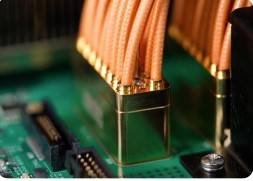
Reducing Interconnect Footprint
Designed to address real estate, cost, and flexible use case issues, the Samtec 71 GHz BE71A Bulls Eye® Phase & Amplitude Test Assembly combines the popular Bulls Eye assembly’s space-saving compression-mount design with Samtec’s distinctive orange NitrowaveTM phase-stable high-performance cables. This new test assembly is optimized for use out to 71GHz in support of 224 Gbps PAM4 SerDes testing. It’s configured in a double-row which supports microstrip/co-planar waveguide or stripline PCB transmissions with 50 ohm impedance.
Because it has a standard 1.85mm connection to instrumentation, the BE71A test assembly eliminates the need to upgrade to the 1.00mm test equipment that is often required for 224 Gbps PAM4 testing.
Why Phase Matching Matters
As frequencies increase, phase matching between cable assemblies becomes more important. This is because precise signal timing is critical when assessing performance or detecting faults in a measurement. The BE71A test assembly offers industry leading 0.5ps phase matching (see Figure 2). This matters for signal integrity, reliability of transmission, and error reduction. The Nitrowave LL071 cables in the BE71A assembly were specifically designed to maintain phase stability while test fixtures and cables are tweaked and adjusted.
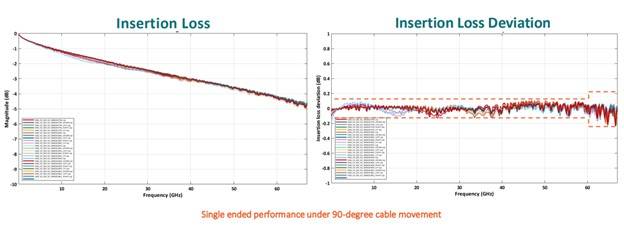
Bulls Eye Background
Samtec released its first Bulls Eye test point system in 2011 for 20GHz connections, and since then the family has rapidly expanded to include 40GHz, 50GHz, 70GHz, 71GHz, 90GHz, and 130GHz (for 448 Gbps testing).

How It’s Being Used
Some Samtec customers who are already working with BE71A test assemblies are integrating them directly into the front panel of test equipment used for 224 Gbps analysis, such as a bit error rate tester (BERT). Outside the box, the BE71A test assembly enables smaller evaluation boards and shorter trace lengths in test and measurement applications. The assembly compression-mounts [1] directly to the board for placement adjacent to the SerDes under characterization, reducing trace length and associated loss.
Configurations Available Now
BE71A test assemblies can be configured with 4 and 8 positions per row. Operating temperature is specified at -65 ˚C to +125 ˚C [2]. To learn more, visit: Samtec.com/BullsEye.
References
- Evolution of Interconnects in Benchtop RF Test | Microwave Journal
- Bulls Eye Test Point System Presentation
