Glass mmWave RF Interconnects
Glass Core Technology (GCT) is Samtec’s ability to design and manufacture quick‑turn, extremely small, advanced glass interconnects that support millimeter wave frequencies through D‑band (170 GHz) and higher. To achieve this we leverage state-of-the-art, 100% in-house, semiconductor-style processing techniques including patterning circuits onto glass and formation of our patented through-glass vias (TGVs). This allows us to deliver advanced glass interconnect solutions that easily scale from prototype to high-volume production.

Glass Interconnects
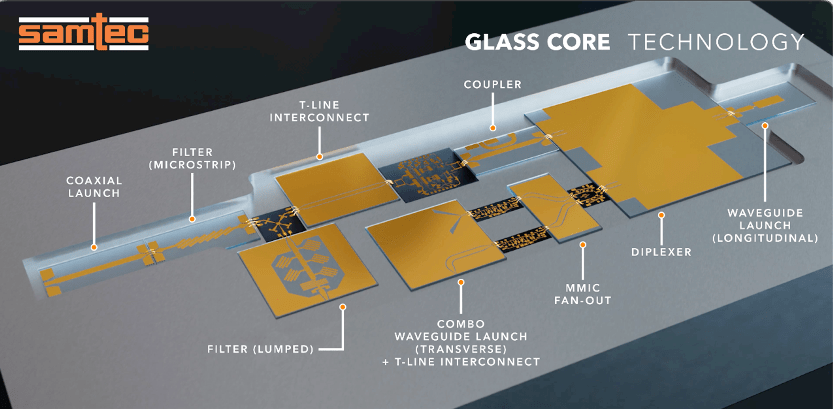
What are advanced glass interconnects? As shown in our High Frequency RF Chain Application below, Samtec GCT enables a portfolio of high-performance interconnect solutions integrated directly into glass. Glass interconnects include waveguide launches, coaxial and twinax launches, fanouts, RF filters, and more. Designed to connect seamlessly to the MMIC, substrate integrated waveguides (SIWs) are available in dramatically smaller, lighter form factors than traditional waveguides. Multiple interconnect options provide the perfect answer to getting the signal from your IC through the rest of the system.
High‑purity Fused Silica is used for GCT interconnect creation due to its clarity and transparency, enabling extremely low loss in high‑frequency millimeter wave applications. With a loss tangent of 0.0003 (100 GHz) and an extremely low dielectric constant (3.8), this material ensures efficient, high‑performance signal transmission. Fused Silica, combined with Samtec’s precise metallization and TGV processes, enables systems to move into frequency targets that weren’t previously achievable with traditional materials, such as ceramics and organics.
Miniaturization
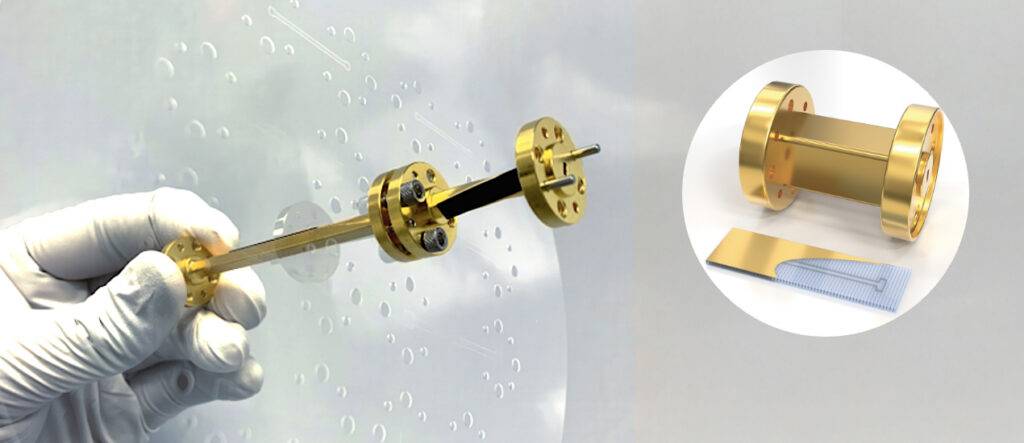
Samtec GCT interconnects enable system-level miniaturization offering significant SWaP advantages over standard solutions. Thin film RDL metallization supports trace width and space down to 10 µm while high aspect ratio, smooth walled through-glass vias enable extremely high density (>6:1). Glass interconnects are also extremely low profile with a flat, uniform thickness.
Repeatability in mmWave Applications
Glass Core Technology enables highly repeatable, low insertion loss performance to 170 GHz and beyond. Samtec’s GCT interconnects also significantly reduce both development time and resources by demonstrating near exact correlation of simulation to measurement. Thanks to these advantages, along with the ones also previously mentioned above, glass interconnects are particularly well-suited for demanding military and aerospace radar, automotive LiDAR, 5G/6G wireless, and SATCOM applications.
To learn more, or to begin your design, contact [email protected]. An Assembly Design Kit (ADK) will be available soon, which will help us to more easily guide you to a quick-turn interconnect solution that best fits your application requirements. Simply tell us your specifications and we’ll send you a design.
Meet Us In-Person at IMS
If you’d like to see our High Frequency RF Chain example in person or speak directly with a Samtec GCT associate, please stop by our booth at the International MTT Symposium (IMS) Exhibition in Boston. Booth #14036, June 9 – June 11. We’d love to have a conversation! For a preview of what you might find when visiting, here is a video of our GCT demonstration from IMS last year: GCT Enables Nokia Bell Lab’s E Band Radio on Glass