
Custom Connectors? It May Be Easier Than You Think …

Do you try to avoid custom connectors? Do you prefer to use a standard, off-the-shelf connector in your designs? Then you’re like almost every other EOEM designer on planet Earth. But sometimes, you can’t find a standard product to meet your design requirements, and you eventually select a custom connector.
I spoke with Mr. Jim Koch, our Director of Custom Products. As usual, he shared some useful, insightful information. Here’s a summary of our conversation.
DANNY: Why do designers shy away from custom connectors?
JIM: Designers typically try to use standard interconnects in their end products. Most cite availability as to why they stick with standard, off-the-shelf products. If you dig deeper, they also express concern about price and second sourcing. But, non-standard (i.e., modified and custom connectors) are more common than most designers think. For example, approximately 25% of Samtec sales are non-standard products ranging from slight modifications of existing products to completely new connector systems.
DANNY: High-speed cable assemblies and mezzanine systems are big sellers at Samtec. Who uses custom high-speed interconnects, and how do they customize them?
JIM: Designers of high-speed systems, like data centers, supercomputers, automated test equipment, and medical imaging, frequently use our high-speed cable assemblies to transfer large volumes of data at high data rates. By “high-speed systems,” I’m referring to data rates of 112 Gbps PAM4 per channel, with 224 just around the corner.
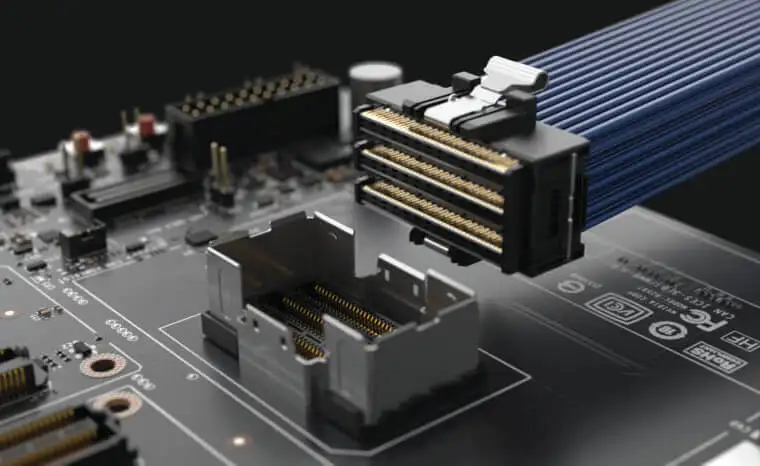
Common modifications include a custom PCB design for pin mapping specific to the application, adding labels on the connectors and cables to identify the part number or provide instructions, and placing protective sleeves around the low-skew twinax cable.
Another popular modification is mixing and matching the assembly’s end 1 and end 2 connectors. For example, a Samtec Flyover® QSFP-DD front panel connector may terminate to any number of high-density end 2 connectors adjacent to the chip. Designers request various connector types for mid-board, back, and front panel interconnect systems.
DANNY: What about designers whose end product doesn’t have a high data rate but something more “typical,” like vision and security systems, embedded products, robotics, industrial automation, etc.?
JIM: These applications frequently use more basic, traditional interconnects like square post terminals (“header”) and socket strips. The relatively simpler design of these stripline plastic insulators and centerlines that are not microminiature (1) make for easy and relatively quick modifications.

Popular modifications include removing pins (i.e., multiple-pin polarization) to allow for signal mapping or additional space for power transfer or creepage and clearance to meet safety and regulatory standards. Other reasons include keying and airflow.
Most board-to-board connectors have well-designed signal-to-ground configurations for SI performance, requiring low-mode conversions to reduce radiated noise or susceptibility to noise. Connectors can be encased in an outer metal shield, encircling the entire mated connector system to minimize the effects of EMI and EMC.

DANNY: Talk to me about RF connectors and cable assemblies. Do we customize those? If so, what are some examples?
JIM: RF connectors and cable assemblies are frequently modified. Popular requests include ganged connectors on tighter centerlines or with odd pin counts. Designers often request ganged RF connectors (such as our MagnumRF™ or Bullseye® Test Point System) with specific pitch, pin counts, and custom layouts. These modifications allow reduced trace lengths or fit the connector into a limited space on their PCB. This permits the connector to be placed closer to the chip.
Phase-matched cabling and labels are also common RF modifications.
DANNY: Keep talking …
JIM: Other modifications include combining power and signal pins into one connector system to provide space savings on the PCB and improve tolerances for mating connector sets. Adding alignment and polarization features like shrouds, lead-ins, and blind mating support, are common custom connector designs.
Plating is another common custom connector, including heavy gold, silver, and palladium nickel, to name a few. Most designers aim for protection against harsh environments, shock and vibration, higher operating temperatures, and higher cycles,
DANNY: Any final words on the matter?
JIM: About 25% of our sales are custom or modified connectors. We design and build these products daily, and they’re probably more affordable than you think. We’re also ranked #1 in new connector design and building custom connectors. If you can’t find a standard connector to meet your design requirements, contact us, and we can talk.
(1) By “not microminiature,” we mean connectors with a centerline of 2.54 or 2.00 mm, not 1.00 or 0.50 mm.
