
Is the Path to 448 Gbps Clear?
Hardly… Could Glass Core Technology Help?
As the industry pushes toward 448 Gbps signaling, every part of the interconnect path is under scrutiny, and some are asking whether glass core technology could be part of the solution. While not a perfect fit for every application, glass offers unique electrical and thermal properties worth exploring in the race to higher speeds.
Why 448 Gbps Means Everything’s Heating Up
The race to 448 Gbps per lane is on, but let’s face it, the path ahead isn’t exactly clear. Signals at these speeds behave like fussy divas, reacting to tiny imperfections, losses, and even heat like never before.
And that heat? It’s driven by a mix of power-hungry transceivers, dense ICs, and the inevitable losses in every interconnect along the way.
With data centers resembling small cities and AI workloads pushing hardware to its limits, designers need every tool at their disposal to meet these new bandwidth targets.
That’s where glass core technology could come into play — an ultra-stable, ultra-low-loss substrate that can help tame some of those wild high-speed signals while keeping those thermal headaches in check.
Why Glass Core? Smooth, Stable, and Ready for 448 Gbps

Traditional PCBs, even the fancy ultra-low-loss kind, hit a wall as speeds rise into the mm-wave range. Copper roughness, variable dielectrics, and thermal expansion can all introduce losses and jitter that collapse your eye diagrams at and above 100 GHz.
By contrast, glass core technology offers:
- Smooth-as-glass copper surfaces that reduce skin-effect losses.
- Ultra-low dielectric losses (~0.003–0.005) that preserve signal integrity.
- Minimal thermal expansion for stable impedance, even as things heat up.
That’s a big deal at 448 Gbps. Glass is basically boring in the best way: stable over temperature, resistant to moisture, and perfect for creating uniform transmission lines that keep your signals on track.
Proof-of-Concept: Nokia Bell Labs’ Radio-on-Glass Breakthrough
If you want a real-world example, look no further than Nokia Bell Labs’ radio-on-glass demonstration powered by Samtec Glass Core Technology.
The first is an E-band backhaul radio — running 71–76 GHz full-duplex — built directly on glass.
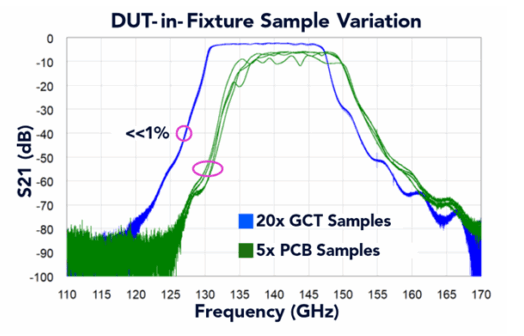
The second is a Bandpass filter comparison with traditional PCB architecture exceeding 100 GHz. Stable impedance. Ultra-low losses. Extreme bandwidth.
By putting their mm-wave circuitry and components on/in the glass, the team achieved consistent signal integrity that traditional PCB materials struggle to match at these frequencies.
These demonstrations prove glass isn’t just a theory, it’s a practical path toward stable, high-speed electronics. Is this a blueprint for how glass could support 448 Gbps channels too?
Thermal Stability — Glass as a Heat-Resistant Ally
Heat is one of the sneakiest villains in high-speed design.
More transceivers, faster links, higher clock rates — all mean more power and more heat.
As your design warms up, most materials begin to warp, expand, and introduce signal variations you really don’t want at these speeds.
Glass core steps in as the stable friend who keeps its cool, with low thermal expansion and consistent properties even as temperatures rise.
That kind of thermal stability is one less thing to worry about for 448 Gbps links, where even tiny dissimilarity in impedance or timing can close your eye. Hopefully, at these high speeds, this should not be a variable. Glass also doesn’t absorb moisture, so you get less variability over time with fewer surprises when your system is fully loaded.
The Role of Connectors and Cables on the 448 Gbps Journey
Of course, glass isn’t the whole story; every link is only as strong as its weakest part. That’s where high-speed connectors and cables come in. Samtec’s proven high-speed connector systems — from dense arrays like SiFly® HD to precision Bulls Eye® test assemblies help keep your signals clean and your design options open.
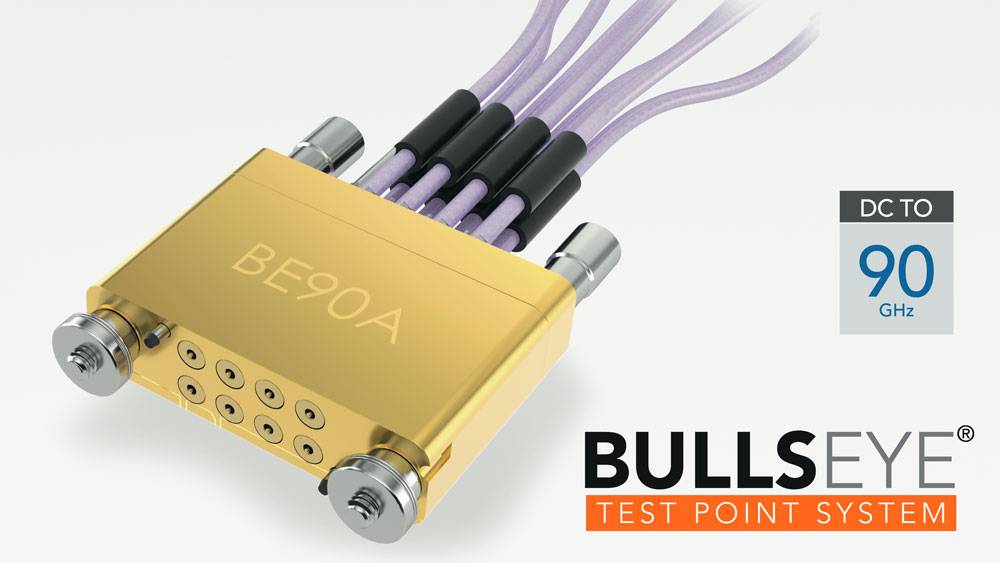
While these solutions may not fully support 448 Gbps link on their own, they lay the foundation by pushing bandwidth up into the 90–110 GHz range, giving you a stable platform to grow toward next-gen rates.
Samtec’s ultra-low-loss cable assemblies, designed for minimal impedance discontinuity and shielding up to 60+ GHz, mean you can connect boards, modules, and test gear without blowing your loss budget.
Design Guidelines for a Glass-Enabled 448 Gbps Channel
If you’re engineering the next-generation link, here are a few design practices that help you leverage glass and state-of-the-art interconnects:
- Go Low-Loss:
- Pick glass or ultra-low-loss substrates.
- Use smooth copper and minimize stubs, backdrill vias and keep traces short and straight.
- Pick glass or ultra-low-loss substrates.
- Keep It Cool & Stable:
- Account for power density, plan thermal paths for heat removal so the glass stays stable.
- Leverage glass’s low CTE to reduce impedance drift as your system warms.
- Account for power density, plan thermal paths for heat removal so the glass stays stable.
- Test Aggressively:
- Measure S-parameters up to 100 GHz.
- Use proven test fixtures like Samtec’s Bulls Eye® to collect accurate data.
- Iterate your design until the eye stays open at your target rates.
- Measure S-parameters up to 100 GHz.
- Integrate Thoughtfully:
- Use connectors and cables that match your channel profile.
- Take advantage of Samtec’s broad catalog, from high-speed test cables to dense arrays, to reduce losses at every interface.
- Use connectors and cables that match your channel profile.
The Future: Glass, Optics, and Co-Packaged Solutions

Looking beyond copper, we know optical engines and co-packaged optics (CPO) will eventually take on long-reach links. You’ll need high-speed electrical paths to connect those engines to the silicon — and glass core is an ideal bridge.
Industry groups, such as OIF CEI-448G and IEEE 802.3, are working to establish standards, and companies like Samtec and Nokia Bell Labs are already demonstrating what’s possible.
As you plan your future designs, glass core technology and next-gen connectors will help you jump that 448 Gbps hurdle — and beyond.
Reality check… is Glass really ready for the road to 448 Gbps?
Glass core technology offers several advantages, including low loss, tight impedance control, and thermal stability, making it a promising option for high-speed signal paths. Glass is not a turnkey solution for full 448 Gbps systems, especially in compute-heavy designs where dense memory interfaces like High Bandwidth Memory (HBM) are critical. Today, glass simply doesn’t offer the wiring density or layer count to support those memory bandwidth demands.
This said, glass could play a valuable role in front-end applications like transceivers, sensing, and chiplet integration. Its low NRE cost and on-shore accessibility also make it a flexible platform for specialized, IO-centric designs.
Glass might not be the end-game substrate for 448 Gbps compute, but it could still be an interesting piece of the puzzle.
Did we pique your interest?
Visit Samtec’s High-Speed Interconnect Solutions or contact our team to explore glass core and connector innovations for your next design.
